Traditional Greek Moussaka Recipe
Greek moussaka is built in layers: tender aubergine (eggplant), sometimes a base of sliced potato, a lamb or beef sauce scented with cinnamon and allspice, and a thick, nutmeg-scented béchamel that bakes to a deep golden crust. It takes a while to make, but each part is simple, it can all be done a day ahead, and one dish feeds a crowd.
This version roasts the aubergine rather than frying it, which uses far less oil and gives a lighter result without losing flavour.
Serves 8. Allow about 1 hour 15 minutes of prep and cooking for the components, 45–50 minutes of baking, and at least 30 minutes of resting.
Ingredients
Vegetables
- 3 medium aubergines (eggplants), about 1.2 kg (2 lb 10 oz)
- 500 g (1 lb 2 oz) floury potatoes, peeled (optional)
- 6 tbsp (90 ml) olive oil, for brushing
- 1 tsp fine salt
Meat sauce
- 1 tbsp (15 ml) olive oil
- 750 g (1 lb 10 oz) minced lamb or beef, or a mix
- 1 large onion (about 200 g), finely chopped
- 3 garlic cloves, finely chopped
- 2 tbsp (32 g) tomato paste
- 120 ml (½ cup) dry red wine
- 400 g (14 oz) can chopped tomatoes, or 400 g passata
- 1 tsp ground cinnamon, or 1 cinnamon stick
- ¼ tsp ground allspice
- 1 tsp dried oregano
- 1 bay leaf
- ½ tsp sugar, if the tomatoes are sharp
- 1 tsp fine salt and ½ tsp black pepper
- 2 tbsp chopped parsley
Béchamel
- 90 g (6 tbsp) butter
- 90 g (¾ cup) plain (all-purpose) flour
- 900 ml (3 ¾ cups) whole milk, warmed
- ¼ tsp freshly grated nutmeg
- ¾ tsp fine salt and a pinch of white pepper
- 2 large egg yolks
- 60 g (¾ cup) finely grated kefalotyri, or Parmesan or pecorino
For the dish
- 2 tbsp dried breadcrumbs
- 20 g (¼ cup) extra grated cheese, for the top
Notes on the main ingredients
Aubergines. Choose firm, glossy aubergines that feel heavy for their size. Modern varieties are rarely bitter, so salting isn’t strictly necessary for bitterness, but salting and resting the slices draws out water and helps them roast to a creamy texture.
Meat. Lamb is common on Greek islands, beef in many mainland homes, and a mix gives you the best of both. Avoid very lean mince, which makes a dry sauce.
Spices. Cinnamon and allspice are what make moussaka taste Greek. They should be noticeable but not sweet. Some cooks also add a pinch of ground cloves.
Cheese. Kefalotyri is a hard, salty Greek sheep’s or goat’s milk cheese. Parmesan, pecorino or Greek kefalograviera are good substitutes.
Making moussaka
Roast the vegetables
- Heat the oven to 220°C (425°F), or 200°C (400°F) fan. Line 2 or 3 large baking trays with baking paper.
- Cut the aubergines lengthways into slices 1 cm (⅜ in) thick. Sprinkle with the salt and leave in a colander for 20 minutes, then pat dry with a clean tea towel.
- Brush both sides of the aubergine slices with oil and lay them on the trays in a single layer. Roast for 20–25 minutes, turning once, until soft and golden.
- If using potatoes, slice them 5 mm (¼ in) thick, toss with a little oil and salt, and roast on a separate tray for 15–20 minutes, until just tender.
Make the meat sauce
- While the vegetables roast, heat the oil in a large frying pan over medium-high heat. Add the mince and cook for 8–10 minutes, breaking it up, until all the liquid has evaporated and the meat has browned. Pour off excess fat if there’s a lot.
- Add the onion and cook for 5 minutes, then the garlic for 30 seconds. Stir in the tomato paste for 1 minute.
- Pour in the wine and let it bubble for 2 minutes. Add the tomatoes, cinnamon, allspice, oregano, bay leaf, sugar, salt and pepper.
- Simmer uncovered over low heat for 30–35 minutes, stirring now and then, until thick and no longer watery. You should be able to drag a spoon through it and see the base of the pan. Remove the bay leaf and cinnamon stick, stir in the parsley and taste for seasoning.
Make the béchamel
- Melt the butter in a medium pan over medium heat. Add the flour and whisk for 2 minutes, until it smells nutty but hasn’t coloured.
- Gradually whisk in the warm milk, about a third at a time, whisking until smooth before each addition. Cook, whisking, for 5–7 minutes, until it has the consistency of thick custard and coats the back of a spoon heavily.
- Off the heat, add the nutmeg, salt, pepper and cheese. Let it cool for 5 minutes, then whisk in the egg yolks quickly so they don’t scramble.
Assemble and bake
- Reduce the oven to 180°C (350°F), or 160°C (325°F) fan. Oil a 23 × 33 cm (9 × 13-inch) baking dish, about 7 cm (2 ¾ in) deep, and scatter the breadcrumbs over the base.
- Layer the potato slices over the base, if using, then half the aubergine. Spread over all the meat sauce, then the rest of the aubergine.
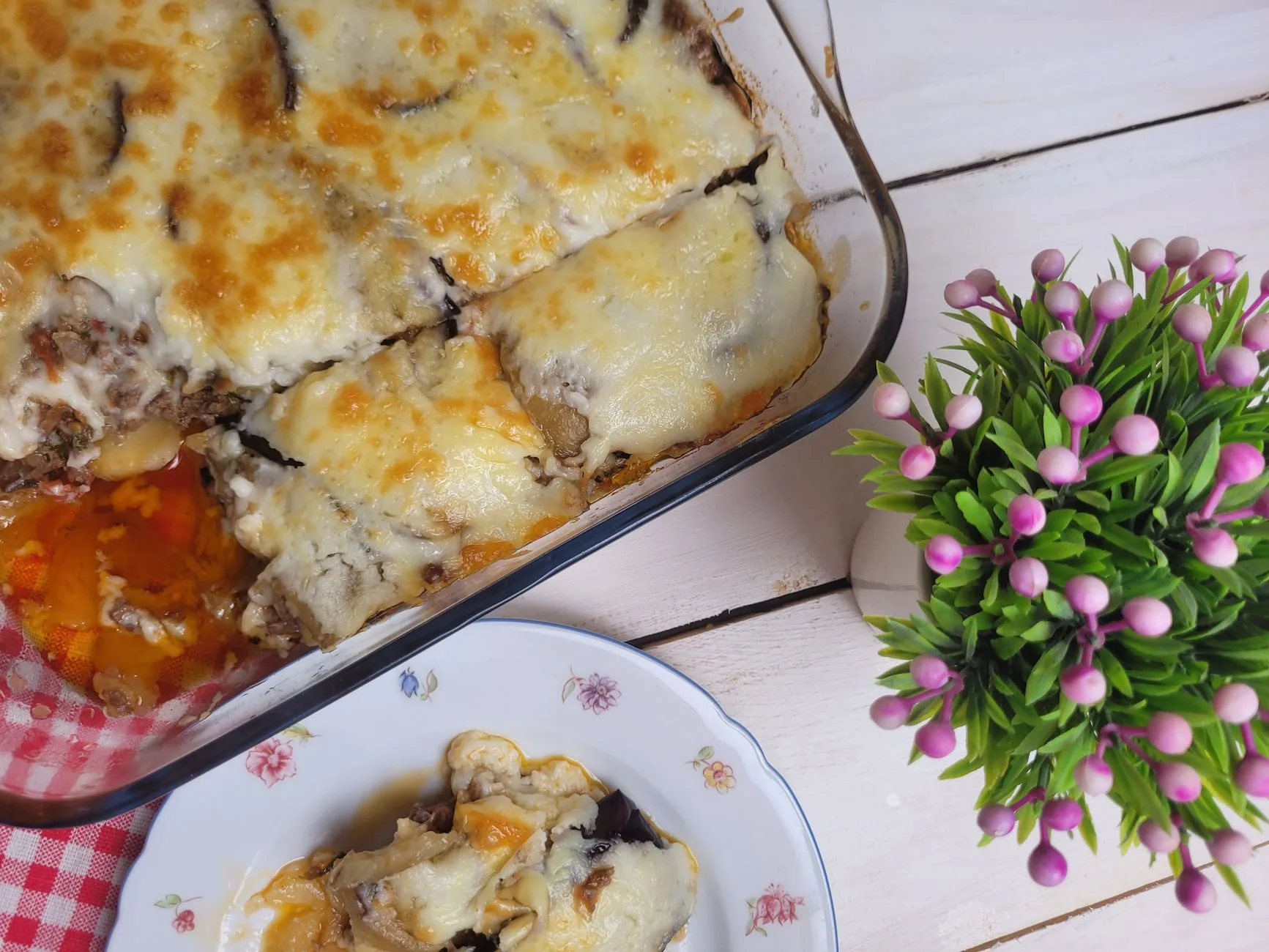
- Pour over the béchamel and smooth it to the edges. It should be about 2–3 cm (1 in) thick. Sprinkle with the extra cheese.
- Set the dish on a baking tray and bake for 45–50 minutes, until the top is deep golden in patches and the sauce bubbles at the edges.
- Leave to rest for at least 30 minutes, and up to an hour, before cutting into squares.
Why the resting time matters
Cut straight from the oven, moussaka slumps across the plate, and the béchamel and juices run into a puddle. As it cools, the béchamel sets and the layers firm up, so each square holds its shape. Moussaka is traditionally served warm rather than piping hot, and its flavour is better that way too.
Common mistakes
- Watery layers. Under-roasted aubergine and thin sauce release liquid. Roast the slices until truly soft and reduce the sauce until thick.
- Lumpy béchamel. Add the milk gradually and whisk constantly. If lumps form, whisk hard or push the sauce through a sieve.
- Scrambled yolks. Let the béchamel cool slightly before adding the yolks.
- Thin topping. The béchamel is a defining layer. Don’t skimp on it.
- Cutting too soon. Give it the full rest.
Substitutions
- Courgette: replace some aubergine with courgette (zucchini) slices, roasted the same way.
- Vegetarian: use cooked brown lentils, or a mix of lentils and finely chopped mushrooms, in place of the meat, simmered in the same sauce.
- Gluten-free: thicken the béchamel with 50 g (6 tbsp) cornflour mixed into a little cold milk instead of the flour roux, and use gluten-free breadcrumbs or leave them out.
- No wine: use stock plus 1 tbsp red wine vinegar.
Make ahead, storage and freezing
- One day ahead: assemble the whole dish, cool, cover and refrigerate. Bake from cold for 60–70 minutes, covering loosely with foil if the top browns too fast, until hot in the centre.
- Components: the meat sauce keeps 3 days in the fridge and freezes for 3 months. Roast the aubergine a day ahead. Make the béchamel on the day.
- Leftovers: keep 4 days in the fridge. Reheat portions, covered, in a 180°C (350°F) oven for 20–25 minutes, or in the microwave.
- Freezing: baked and cooled moussaka freezes well, in portions or whole, for up to 3 months. Thaw overnight in the fridge before reheating.
Serving ideas
Serve moussaka with a simple Greek salad of tomato, cucumber, red onion, olives and feta, or with crisp lettuce in a lemony dressing, and bread for the plate. Our Mediterranean chickpea salad also works well. For a quicker Greek dinner on a weeknight, try our Greek chicken souvlaki with tzatziki.
For more on cooling, freezing and reheating, see our make-ahead, storage and freezing guide.
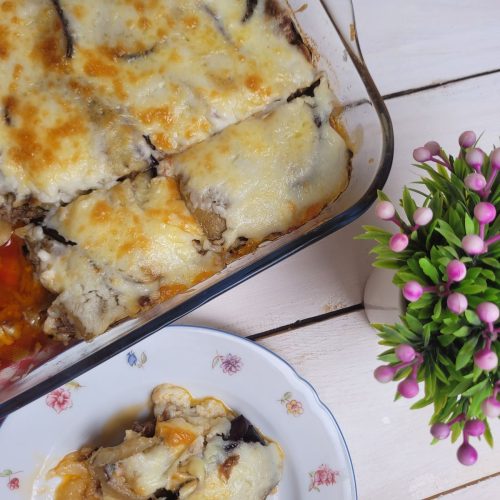
Traditional Greek Moussaka
Ingredients
Vegetables
- 3 medium aubergines (eggplants), about 1.2 kg (2 lb 10 oz)
- 500 g (1 lb 2 oz) floury potatoes, peeled (optional)
- 6 tbsp (90 ml) olive oil
- 1 tsp fine salt
Meat sauce
- 1 tbsp (15 ml) olive oil
- 750 g (1 lb 10 oz) minced lamb or beef, or a mix
- 1 large onion (about 200 g), finely chopped
- 3 garlic cloves, finely chopped
- 2 tbsp (32 g) tomato paste
- 120 ml (½ cup) dry red wine
- 400 g (14 oz) can chopped tomatoes or passata
- 1 tsp ground cinnamon or 1 cinnamon stick
- ¼ tsp ground allspice
- 1 tsp dried oregano
- 1 bay leaf
- ½ tsp sugar (optional)
- 1 tsp fine salt and ½ tsp black pepper
- 2 tbsp chopped parsley
Béchamel
- 90 g (6 tbsp) butter
- 90 g (¾ cup) plain flour
- 900 ml (3 ¾ cups) whole milk, warmed
- ¼ tsp grated nutmeg
- ¾ tsp fine salt and a pinch of white pepper
- 2 large egg yolks
- 60 g (¾ cup) grated kefalotyri or Parmesan
For the dish
- 2 tbsp dried breadcrumbs
- 20 g (¼ cup) extra grated cheese
Instructions
- Heat the oven to 220°C (425°F), or 200°C (400°F) fan. Slice the aubergines lengthways 1 cm (⅜ in) thick, salt for 20 minutes and pat dry.
- Brush with oil and roast 20–25 minutes, turning once, until soft and golden. Roast the sliced potatoes separately for 15–20 minutes, if using.
- Brown the mince for 8–10 minutes. Add the onion for 5 minutes, garlic for 30 seconds and tomato paste for 1 minute.
- Add the wine for 2 minutes, then the tomatoes, spices, oregano, bay, sugar, salt and pepper. Simmer uncovered 30–35 minutes until thick. Stir in the parsley.
- For the béchamel, cook the butter and flour for 2 minutes, whisk in the warm milk gradually and cook 5–7 minutes until thick. Off the heat, add the nutmeg, seasoning and cheese, cool 5 minutes and whisk in the yolks.
- Lower the oven to 180°C (350°F), or 160°C (325°F) fan. Oil the dish and scatter with breadcrumbs.
- Layer the potatoes, half the aubergine, all the meat sauce and the rest of the aubergine. Top with the béchamel and extra cheese.
- Bake 45–50 minutes until deep golden and bubbling.
- Rest at least 30 minutes before cutting.
Notes
- Make ahead: assemble a day ahead, refrigerate and bake from cold for 60–70 minutes.
- Meat sauce keeps 3 days in the fridge or 3 months frozen.
- Vegetarian: replace the meat with cooked brown lentils and mushrooms.
- Leftovers keep 4 days. Baked moussaka freezes for 3 months.
From Spain, try our seafood paella.
A short history
Dishes of layered aubergine and meat are found across the eastern Mediterranean, the Balkans and the Middle East, often under the same name. Many have no béchamel and are closer to a stew. The Greek version with its thick béchamel crust is generally credited to Nikolaos Tselementes, an influential chef and cookbook author who trained in Europe. In the 1920s he set out to give Greek home cooking a French polish, and his cookbook made this layered, béchamel-topped moussaka the one now known around the world.