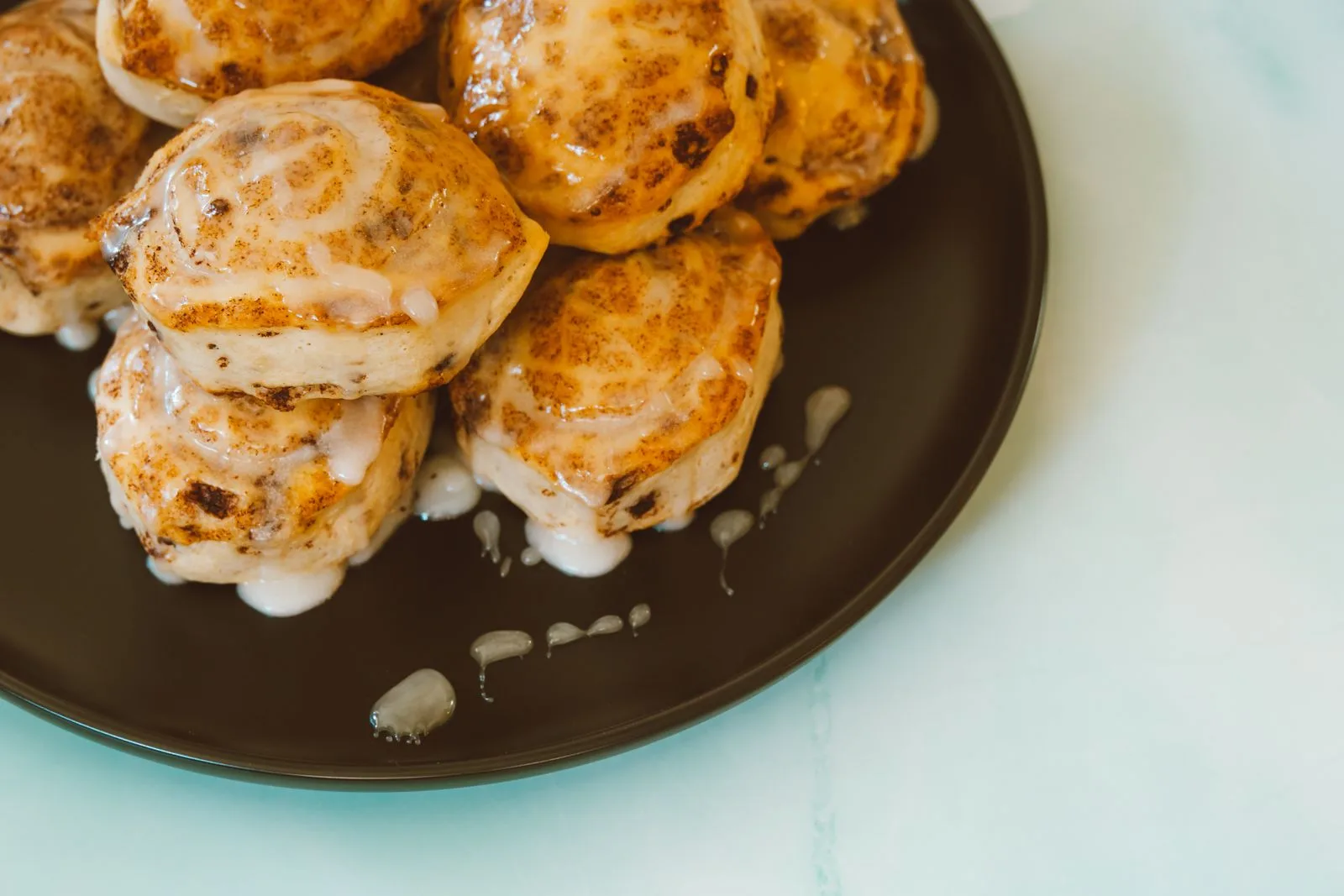
Homemade Brioche Cinnamon Rolls
These cinnamon rolls are made with a brioche-style dough enriched with eggs, milk and butter, so they bake up soft, rich and tender, almost pulling apart in strands. They’re filled with butter, brown sugar and cinnamon, baked close together in one pan, and spread with cream cheese icing while still warm. They can be shaped the night before and baked in the morning.
Makes 12 rolls in a 23 × 33 cm (9 × 13-inch) pan. Allow about 45 minutes of hands-on time, 2 ½–3 hours of rising, and 25 minutes of baking.
Why brioche dough?
A standard cinnamon roll dough is a lightly sweetened bread dough. Brioche adds eggs and much more butter, which makes the crumb richer, more tender and more golden. The trade-off is that brioche dough is softer and stickier, and it rises more slowly, because fat and sugar slow the yeast. Knead well before the butter goes in, give the dough time, and the result is worth it.
Ingredients
Dough
- 180 ml (¾ cup) whole milk, warmed to 38°C (100°F)
- 7 g (2 ¼ tsp, 1 sachet) instant or active dry yeast
- 65 g (⅓ cup) granulated sugar
- 3 large eggs (about 150 g without shells), at room temperature
- 1 tsp vanilla extract
- 450 g (3 ¾ cups) plain (all-purpose) or bread flour, plus up to 30 g (¼ cup) more
- 6 g (1 tsp) fine salt
- 115 g (½ cup) unsalted butter, very soft, cut into pieces
Filling
- 75 g (5 tbsp) unsalted butter, very soft
- 150 g (¾ cup, packed) light brown sugar
- 16 g (2 tbsp) ground cinnamon
- A pinch of salt
Cream cheese icing
- 115 g (4 oz) full-fat cream cheese, at room temperature
- 40 g (3 tbsp) unsalted butter, softened
- 180 g (1 ½ cups) icing (powdered) sugar, sifted
- 1 tsp vanilla extract
- A pinch of salt
- 1–2 tbsp (15–30 ml) milk
Notes on flour, sugar and butter
Flour. Plain flour gives a softer, more cake-like roll; bread flour gives a little more chew and holds its shape better in the rich dough. Both work. Weigh it if you can. If you use cups, spoon the flour into the cup and level it, rather than scooping, or you can easily add 20% too much and end up with dry rolls.
Sugar. The 65 g in the dough is enough to flavour it and help it brown without slowing the yeast too much. The filling uses light brown sugar, whose molasses gives a deeper, caramel flavour and helps the filling stay moist. Dark brown sugar works too, with a stronger flavour.
Butter for both the dough and the filling must be very soft, like mayonnaise, but not melted. Melted butter in the filling leaks out during baking and pools in the pan.
Yeast. Instant yeast can be added straight to the flour. Active dry yeast should be dissolved in the warm milk with a pinch of the sugar for 5–10 minutes, until foamy. If it doesn’t foam, it’s dead, so start again with fresh yeast.
Method
Make the dough
- In the bowl of a stand mixer, whisk the warm milk, yeast and a pinch of the sugar. If using active dry yeast, leave it for 5–10 minutes until foamy.
- Add the rest of the sugar, the eggs and vanilla and whisk to combine. Add the 450 g flour and the salt and mix on low speed with the dough hook for 2–3 minutes, until a shaggy dough forms.
- Knead on medium-low speed for 5 minutes. The dough will be sticky but should start to pull away from the sides of the bowl.
- With the mixer running, add the soft butter a piece at a time, waiting until each is absorbed before adding the next. This takes about 5 minutes. The dough will look greasy and broken at first, then come back together.
- Knead for another 5–8 minutes, until the dough is smooth, glossy and elastic, and pulls cleanly away from the sides of the bowl. It should feel tacky but not leave dough on your fingers. A small piece stretched between your fingers should form a thin, translucent windowpane. If it’s still very sticky after 8 minutes, add flour 1 tablespoon at a time, up to 30 g. By hand, the whole process takes about 20 minutes of kneading, and a dough scraper helps.
First rise
- Shape the dough into a ball and put it in a lightly buttered bowl. Cover and leave in a warm place, about 24–26°C (75–79°F), for 1 ½–2 hours, until doubled in size. A floured finger pressed in should leave a dent that springs back slowly.
Shape the rolls
- Butter the pan or line it with baking paper. Mix the brown sugar, cinnamon and salt for the filling.
- Turn the dough onto a lightly floured surface and roll it into a rectangle about 30 × 45 cm (12 × 18 in), with a long side facing you. If it springs back, rest it for 5 minutes.
- Spread the soft butter evenly over the dough, leaving a 1 cm (½ in) bare strip along the far edge. Sprinkle the cinnamon sugar evenly over the butter and press it in lightly.
- Starting from the long side nearest you, roll the dough up firmly but without stretching it. Pinch the seam closed and turn the log seam-side down.
- Trim the ends, then cut the log into 12 pieces of about 3.5 cm (1 ⅜ in) with a sharp serrated knife, or by looping unflavoured dental floss under the log and crossing it over the top. Arrange them in the pan, cut side up, in 3 rows of 4, with small gaps between them.
Second rise and bake
- Cover and leave in a warm place for 45–60 minutes, until the rolls are puffy and touching each other. Heat the oven to 180°C (350°F), or 160°C (325°F) fan, with a shelf in the centre.
- Bake for 22–26 minutes, until the tops are evenly golden brown and the centre roll reaches 88–90°C (190–195°F) on a thermometer. If the tops brown too fast, cover loosely with foil for the last 5–10 minutes.
- While the rolls bake, beat the cream cheese and butter until smooth, then beat in the icing sugar, vanilla and salt. Add milk a little at a time until spreadable.
- Cool the rolls in the pan for 10–15 minutes, then spread the icing over them. It should melt slightly into the swirls without running off completely.
How pan size and material change the bake
- 23 × 33 cm (9 × 13-inch) pan, 12 rolls: the standard. The rolls rise into each other and bake into tall, soft-sided rolls that pull apart. Bake 22–26 minutes.
- Two 23 cm (9 in) round pans, 6 or 7 rolls each: slightly more space per roll, so they bake a little faster, in about 20–24 minutes. They’re handy for baking one pan and freezing the other.
- Large sheet pan, rolls spaced well apart: the rolls spread outward rather than up, with more browned, crusty edges. Bake 18–22 minutes.
- Smaller pan, such as 20 × 30 cm (8 × 12 in): tightly packed rolls rise higher and take longer to cook in the middle, about 28–32 minutes. Check the centre roll’s temperature.
- Material: dark metal pans brown faster, so check 3–4 minutes early. Glass and ceramic heat more slowly and can need 3–5 minutes longer, and the bottoms may be paler.
Overnight option
After shaping, cover the pan tightly and refrigerate for 8–16 hours. In the morning, take it out and leave it somewhere warm for 45–75 minutes, until the rolls are puffy and touching, then bake as above. Cold dough also slices more cleanly, so some bakers chill the log for 30 minutes before cutting.
Common mistakes
- Adding too much flour. Brioche dough is meant to be soft. Extra flour gives dry, dense rolls. Knead longer before deciding it needs more.
- Under-rising. Enriched dough is slow. Go by the look and the poke test rather than the clock.
- Rolling too loosely or too tightly. Loose rolls separate into gaps; tight rolls pop up in the middle as they bake. Roll firmly but gently.
- Underbaking. The centre roll can be doughy when the edges look done. Use a thermometer or check that the centre roll is golden between the swirls.
- Icing hot rolls. Straight from the oven, the icing melts and runs off.
Storage and freezing
Iced rolls are best on the day. Store leftovers covered at room temperature for 1 day, or in the fridge for up to 4 days, and warm them in the microwave for 15–20 seconds. To freeze, cool the baked rolls without icing, wrap them well and freeze for up to 2 months. Thaw at room temperature, warm in a 160°C (325°F) oven for 10 minutes, then ice. Unbaked shaped rolls can also be frozen in the pan; thaw them overnight in the fridge, then let them rise and bake as for the overnight option.
Serving and background
Serve warm with coffee for breakfast or brunch. For a weekend brunch table, they pair well with our Japanese soufflé pancakes, and if you like cinnamon and brown sugar, try our classic apple pie from scratch.
Cinnamon-swirled yeast buns are found across northern Europe, most famously the Swedish kanelbulle, which became popular after the First World War and now has its own day, on 4 October. The large, iced cinnamon roll is an American development, sold in bakeries since the 20th century. Using a French-style brioche dough is a modern bakery variation that combines the two traditions.
Measuring in cups or need a different oven setting? See our kitchen conversions guide.
For more on cooling, freezing and reheating, see our make-ahead, storage and freezing guide.
Homemade Brioche Cinnamon Rolls
Ingredients
Dough
- 180 ml (¾ cup) whole milk, warmed to 38°C (100°F)
- 7 g (2 ¼ tsp) instant or active dry yeast
- 65 g (⅓ cup) granulated sugar
- 3 large eggs (about 150 g), at room temperature
- 1 tsp vanilla extract
- 450 g (3 ¾ cups) plain or bread flour, plus up to 30 g (¼ cup)
- 6 g (1 tsp) fine salt
- 115 g (½ cup) unsalted butter, very soft
Filling
- 75 g (5 tbsp) unsalted butter, very soft
- 150 g (¾ cup, packed) light brown sugar
- 16 g (2 tbsp) ground cinnamon
- pinch of salt
Cream cheese icing
- 115 g (4 oz) full-fat cream cheese, softened
- 40 g (3 tbsp) unsalted butter, softened
- 180 g (1 ½ cups) icing sugar, sifted
- 1 tsp vanilla extract
- pinch of salt
- 1–2 tbsp (15–30 ml) milk
Instructions
- Whisk the warm milk, yeast and a pinch of sugar (leave active dry yeast 5–10 minutes until foamy).
- Add the remaining sugar, eggs and vanilla, then the flour and salt. Mix on low for 2–3 minutes, then knead on medium-low for 5 minutes.
- Add the butter a piece at a time, then knead 5–8 minutes more until smooth, glossy, tacky and passing the windowpane test.
- Cover and rise in a warm place for 1 ½–2 hours until doubled.
- Roll into a 30 × 45 cm (12 × 18 in) rectangle. Spread with the soft butter and sprinkle with the cinnamon sugar, leaving a 1 cm (½ in) border on the far edge.
- Roll up from the long side, seal, and cut into 12 pieces. Arrange in the buttered pan.
- Rise 45–60 minutes until puffy and touching. Heat the oven to 180°C (350°F), or 160°C (325°F) fan.
- Bake 22–26 minutes until golden and 88–90°C (190–195°F) in the centre roll.
- Beat the cream cheese and butter, then the icing sugar, vanilla, salt and enough milk to spread.
- Cool the rolls 10–15 minutes, then ice and serve warm.
Notes
- Overnight: refrigerate the shaped rolls 8–16 hours, then rise 45–75 minutes before baking.
- Pan size: two 23 cm (9 in) round pans bake in 20–24 minutes; a smaller 20 × 30 cm (8 × 12 in) pan needs 28–32 minutes.
- Dark metal pans brown faster; glass or ceramic may need 3–5 minutes longer.
- Spoon and level the flour if using cups; too much flour makes dry rolls.
- Freeze baked, un-iced rolls for up to 2 months.
Photo: Jess Loiterton on Pexels