Homemade Margherita Pizza Dough
A good Margherita needs only a handful of ingredients: dough, tomatoes, mozzarella, basil, olive oil and salt. That makes the dough the part worth getting right. This recipe gives exact weights for two 30 cm (12 in) pizzas, with a same-day schedule and a cold-fermented version that develops more flavour, plus how to get the best from a home oven, which runs much cooler than a pizzeria’s.
Makes 2 pizzas, enough for 2–4 people. Hands-on time is about 30 minutes. Allow 2–3 hours for a same-day dough or 24–72 hours for a cold-fermented one.
The dough formula
Pizza makers usually describe dough in baker’s percentages, where every ingredient is a percentage of the flour weight. This dough is 65% water, 2% salt and about 3% olive oil. That hydration is easy to handle by hand and bakes up crisp underneath with an open, airy rim in a domestic oven. Weigh everything if you can, especially the water and salt. Cup measures for flour can vary by 20% or more.
Ingredients
Dough (2 balls of about 255 g each)
- 300 g (2 ½ cups) bread flour or Italian “00” flour, plus extra for dusting
- 195 g (195 ml / ¾ cup plus 1 tbsp) lukewarm water, about 25°C (77°F)
- 6 g (1 tsp) fine sea salt
- 2 g (⅔ tsp) instant yeast for same-day dough, or 1 g (⅓ tsp) for cold-fermented dough
- 10 g (2 tsp) extra-virgin olive oil
- 4 g (1 tsp) sugar or honey (optional, helps browning in a home oven)
- Semolina or extra flour, for the peel
Margherita topping (for 2 pizzas)
- 400 g (14 oz) can whole peeled plum tomatoes, such as San Marzano
- ½ tsp fine sea salt
- 250 g (9 oz) fresh mozzarella (fior di latte), or 200 g (7 oz) low-moisture mozzarella
- A handful of fresh basil leaves
- Extra-virgin olive oil, for drizzling
- 20 g (¼ cup) grated Parmesan (optional)
Flour, yeast and water
Flour. Italian “00” refers to how finely the flour is milled, not its strength. “00” made for pizza is fairly strong and gives a soft, tender crust. Most Italian “00” flour has no malted barley added, so it browns slowly at home-oven temperatures. Strong bread flour often includes malt and gives a crisper, more golden crust in a home oven. Either works; many home cooks use a 50:50 mix.
Yeast. Instant yeast can be mixed straight into the flour. If you only have active dry yeast, use 3 g (1 tsp) for same-day dough and dissolve it in the water first. For fresh yeast, use three times the instant yeast weight.
Water temperature controls how fast the dough rises. Lukewarm water suits a same-day dough. For a cold ferment, cool tap water is fine.
Making the dough
- Mix. In a large bowl, whisk the flour and yeast. Add the water, oil and sugar, if using, and mix with a spoon or your hand until no dry flour remains. Cover and leave for 20 minutes. This rest hydrates the flour and makes kneading easier.
- Add the salt and knead. Sprinkle the salt over the dough and knead it in. Knead on an unfloured worktop for 8–10 minutes, or 6–7 minutes in a stand mixer with the dough hook on low speed, until the dough is smooth, elastic and slightly tacky but no longer sticky. A small piece stretched gently should go thin enough to let light through before it tears.
- First rise. Shape into a ball, put it in a lightly oiled bowl and cover. For same-day dough, leave it at warm room temperature, about 22–24°C (72–75°F), for 1 ½–2 hours, until roughly doubled. For cold-fermented dough, leave it for 1 hour at room temperature, then go straight to step 4.
- Divide and ball. Turn the dough out and cut it into two equal pieces of about 255 g. Shape each into a tight ball by folding the edges into the middle, then turning it over and rolling it under your cupped hand until the surface is smooth and taut.
- Second rise. Put the balls on a floured tray or in oiled containers and cover. Same-day dough needs 45–60 minutes at room temperature, until puffy and soft. Cold-fermented dough goes into the fridge for 24–72 hours; take the balls out 2–3 hours before baking so they come up to room temperature.
Preparing the toppings
Crush the tomatoes by hand or pulse briefly in a food processor, leaving some texture, and stir in the salt. Don’t cook the sauce; it cooks on the pizza. Tear fresh mozzarella into pieces and leave them in a sieve for 30 minutes to drain, then pat dry. Grate or slice low-moisture mozzarella.
Baking in a home oven
- Heat the oven. Put a pizza steel or stone on a shelf in the upper third of the oven and heat it to the highest setting, usually 250–290°C (480–550°F), for at least 45 minutes and ideally an hour. A steel conducts heat faster and gives a crisper base. Without either, heat a heavy baking tray upside down.
- Shape. Dust a ball and the worktop with flour. Press the dough out from the centre with your fingertips, leaving a 2 cm (¾ in) rim untouched. Then lift it and stretch it gently over your knuckles, turning it, until it’s about 30 cm (12 in) across. Don’t use a rolling pin, which pushes the air out of the rim.
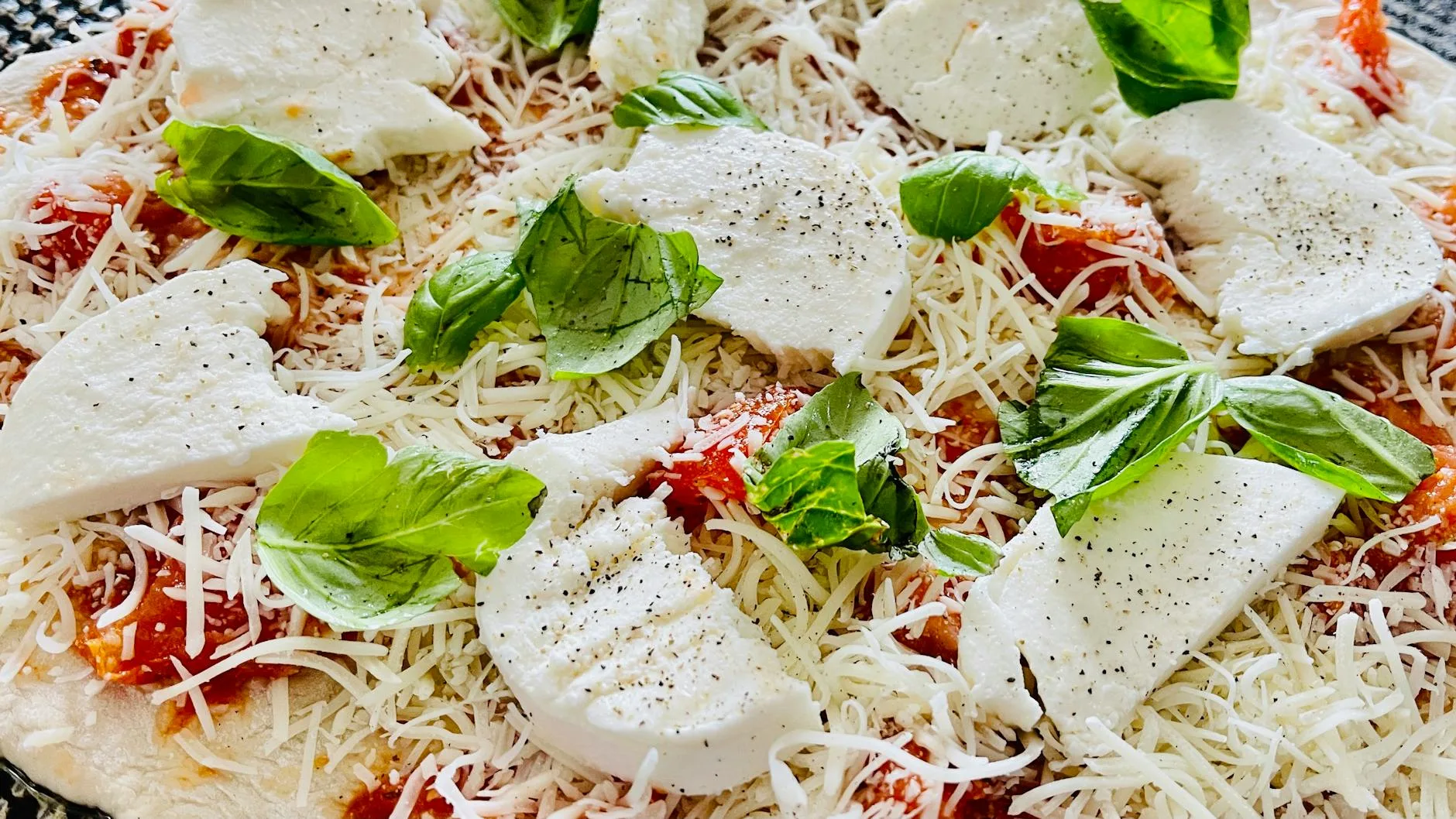
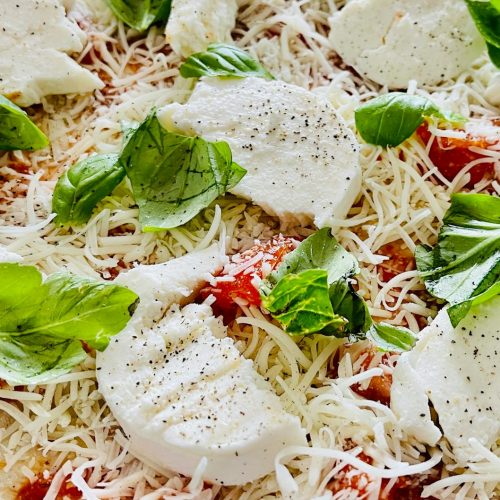
- Top. Lay the dough on a peel or flat tray dusted with semolina. Spread on about 5 tablespoons (80–100 g) of tomato, leaving the rim bare. Scatter over half the mozzarella and a few basil leaves, and drizzle with olive oil. Work quickly so the dough doesn’t stick.
- Bake. Slide the pizza onto the hot steel or stone. Bake for 6–9 minutes on a steel or 8–12 minutes on a stone, until the rim is puffed and browned with darker spots and the cheese is bubbling. For more colour on top, switch to the grill (broiler) for the last 1–2 minutes and watch closely.
- Finish. Add fresh basil and a drizzle of oil, and some Parmesan, if using. Rest for a minute before slicing. Let the steel or stone reheat for 5–10 minutes before baking the second pizza.
Troubleshooting
- Dough springs back when stretched. The gluten is tight. Cover it and wait 10–15 minutes, then try again.
- Dough tears. It may be under-kneaded or under-proofed. Patch the hole by pinching, and knead a little longer next time.
- Soggy middle. Too much sauce, wet mozzarella or an under-heated stone. Use less sauce, drain the cheese and preheat longer.
- Pale crust. The oven wasn’t hot enough, or the flour has no malt. Add the sugar or honey, or finish under the grill.
- Pizza sticks to the peel. Use more semolina, and give the peel a little shake before you open the oven, to check the pizza slides.
Make ahead and freezing
Dough balls can be frozen after the first rise and balling. Oil them lightly, freeze in individual bags for up to 3 months, thaw overnight in the fridge, then leave at room temperature for 2–3 hours before shaping. Cold-fermented dough keeps in the fridge for up to 72 hours. After that it starts to taste sour and becomes slack. Leftover baked pizza keeps 2 days in the fridge. Reheat slices in a dry frying pan over medium heat with a lid on for 3–4 minutes, so the base crisps while the cheese melts.
A brief history
Flatbreads with toppings were sold as street food in Naples by the 18th century. The best-known story says that in 1889 the pizzaiolo Raffaele Esposito made a pizza in the colours of the Italian flag for Queen Margherita of Savoy, with red tomato, white mozzarella and green basil, and named it after her. Historians treat the details with some caution, and similar pizzas were already being made. Even so, the Margherita has become the reference pizza. In 2017 UNESCO recognised the art of the Neapolitan pizzaiuolo as Intangible Cultural Heritage. This home-oven recipe isn’t a true Neapolitan pizza, which is baked in about 90 seconds in a wood-fired oven at around 430–480°C, but it follows the same simple idea.
What to serve alongside
A rocket salad with lemon and Parmesan is a natural partner. If you have tomato sauce and mozzarella left over, they work well in our spinach ricotta stuffed shells, and our classic no-bake tiramisu can be made the day before for an all-Italian pizza night.
Homemade Margherita Pizza Dough
Ingredients
Dough
- 300 g (2 ½ cups) bread flour or “00” flour
- 195 g (195 ml) lukewarm water, about 25°C (77°F)
- 6 g (1 tsp) fine sea salt
- 2 g (⅔ tsp) instant yeast (same-day) or 1 g (⅓ tsp) (cold ferment)
- 10 g (2 tsp) extra-virgin olive oil
- 4 g (1 tsp) sugar or honey (optional)
- semolina, for the peel
Margherita topping
- 400 g (14 oz) can whole peeled plum tomatoes
- ½ tsp fine sea salt
- 250 g (9 oz) fresh mozzarella, torn and drained, or 200 g (7 oz) low-moisture mozzarella
- fresh basil leaves
- extra-virgin olive oil
- 20 g (¼ cup) grated Parmesan (optional)
Instructions
- Mix the flour, yeast, water, oil and sugar until no dry flour remains. Cover and rest 20 minutes.
- Add the salt and knead 8–10 minutes until smooth, elastic and slightly tacky.
- Same-day: rise 1 ½–2 hours at 22–24°C (72–75°F) until doubled. Cold ferment: rest 1 hour.
- Divide into 2 balls of about 255 g and shape tightly.
- Same-day: rest 45–60 minutes. Cold ferment: refrigerate 24–72 hours, then bring to room temperature for 2–3 hours.
- Heat a steel or stone in the upper third of the oven at the highest setting, 250–290°C (480–550°F), for 45–60 minutes.
- Crush the tomatoes with the salt. Drain the mozzarella.
- Stretch each ball by hand to 30 cm (12 in), leaving a 2 cm (¾ in) rim.
- Top with 80–100 g tomato, half the mozzarella, basil and a drizzle of oil.
- Bake 6–9 minutes on a steel or 8–12 minutes on a stone, using the grill for the last 1–2 minutes if needed. Finish with basil and oil.
Notes
- Weigh the flour, water and salt for consistent results.
- Bread flour browns better than malt-free 00 in a home oven; the optional sugar also helps.
- Active dry yeast: use 3 g (1 tsp) for same-day dough, dissolved in the water.
- Freeze dough balls after shaping for up to 3 months; thaw overnight in the fridge.
- Reheat leftover slices in a covered dry frying pan for 3–4 minutes.
Photo: Christopher Seufert on Pexels